Brows, Contour & Blusher Guide
Practical, real-world techniques for shaping the brows, softening facial proportions and restoring natural colour after a full-coverage makeup base.
Three details that can transform the whole face
Brows, contour and blusher do different jobs, but they work best as one balanced stage of a male-to-feminine makeup routine. The aim is not to draw a completely different face. It is to use light, shade, shape and colour to soften and enhance the features already there.
Sophie’s principle: build gradually, blend as you go and keep looking at the whole face. A technique that works beautifully for an evening look may be much stronger than you need for daytime.
Jump to the technique you need
Define the brow without making it look heavy
Eyebrow powder — Sophie’s preference
Sophie normally prefers an eyebrow powder palette. It makes it easy to strengthen the shape, fill gaps and build a more defined, almost tattooed appearance without immediately creating a hard pencil line.
View Eyebrow Powder PaletteBrow pencil — use sparingly
A pencil can add definition where it is needed. Sophie’s approach is to use it sparingly and blend as she goes rather than drawing one solid line. Kryolan Faceliner is one suitable option.
View Kryolan FacelinerDo not underestimate the brow brush
A brow brush is a simple but extremely useful tool. Brush the hairs into shape first, then use it again after adding colour to soften and distribute the product. Sophie also finds a brow brush useful when defining and blending lip colour.
Change the impression of the brow without removing it
Natural brows do not always sit exactly where you would choose to draw a feminine brow. That does not mean they must be completely covered.
One of Sophie’s useful tricks is to work a light-reflecting eyeshadow into the hairs around the outer edge of the brow. The reflected light helps those hairs recede visually, allowing the apparent brow shape to be adjusted without a heavy layer of covering product.
It is a subtle optical technique, so experiment in good light and keep checking the result from normal viewing distance rather than only in a close-up mirror.
Why Sophie usually avoids brow blocking
Full brow blocking can be very effective for theatrical and drag makeup, where the intention may be to cover the natural brow completely and redraw it in a dramatically different position.
For Sophie’s usual daytime and real-world feminisation work, she prefers powder, careful reshaping, light reflection and lifting. In her experience, the heavier layers needed for brow blocking can become visible or crack with wear, which is one reason theatrical looks may use stronger decoration or glitter over the area.
Facelift tapes can open the eye and brow area
Sophie routinely uses a face-tape method as part of her own transformation. By lifting around the temple and outer brow area, the technique can change the apparent brow position, open the eye area and alter the overall impression of the face before the makeup is completed.
The amount and direction of lift are personal. The important point is that the tape is part of the structure of the finished look, so it is applied before the makeup stages that depend on the new position of the skin and brow.
Follow the instructions supplied with the tape or adhesive system you use, avoid irritated or damaged skin, and stop if the skin becomes uncomfortable.
See the technique in context
Sophie’s Crossdressing Lifestyle makeover videos show how lifting, makeup and styling work together rather than treating each technique as an isolated trick.
Watch Sophie’s step-by-step makeoverExplore the makeup playlist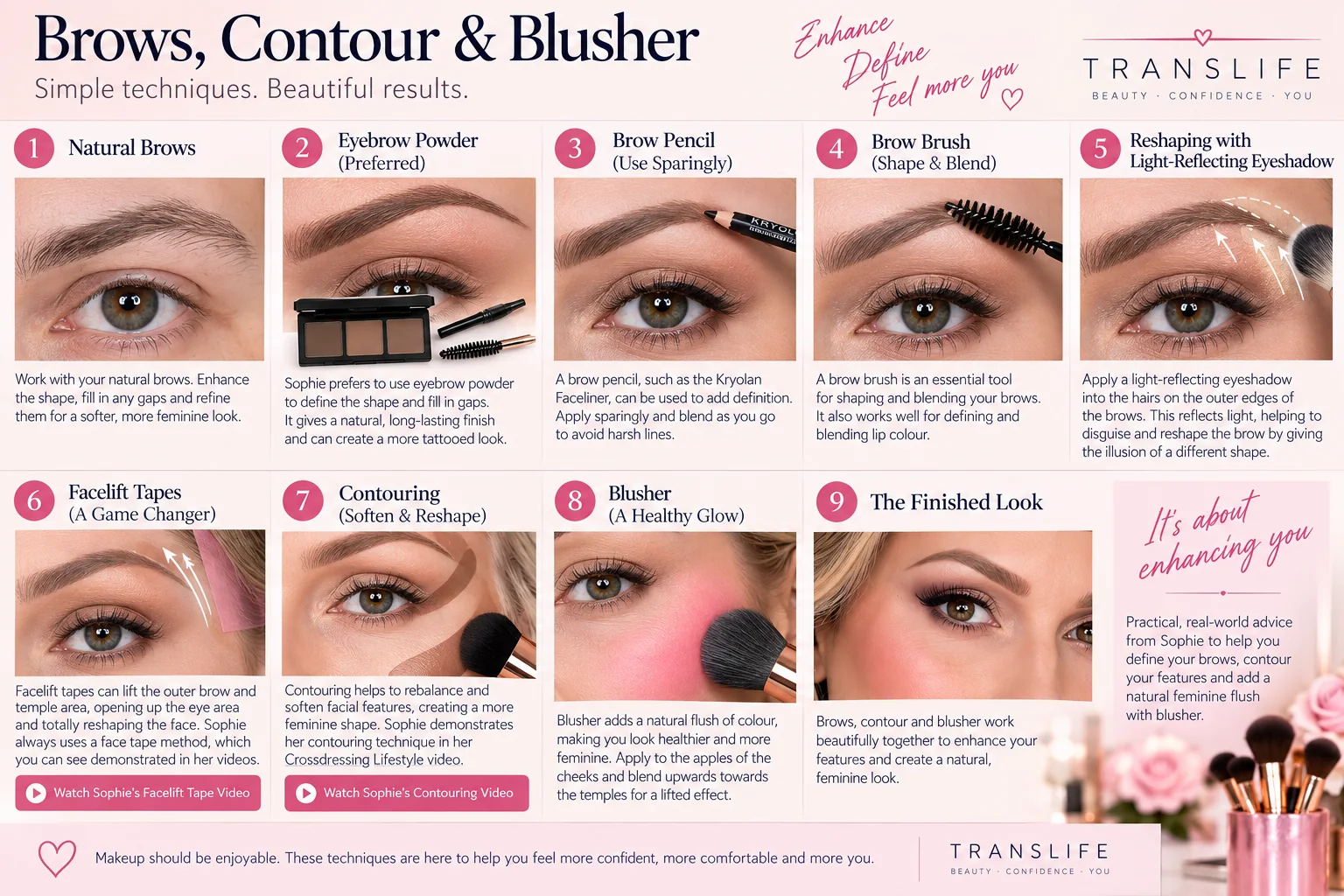
Use shadow to soften and rebalance proportions
Contour works by creating controlled areas of shadow. For male-to-feminine makeup, that can help soften the impression of stronger facial proportions, but the placement should respond to the individual face rather than follow a rigid diagram.
Start with less than you think
Build gradually. It is much easier to deepen a contour than to rescue a dark stripe sitting on top of a finished foundation base.
Place according to the face
Common areas include the temples or hairline, beneath the cheekbone, the jawline and, where useful, the sides of the nose. You do not need to contour every area.
Blend until the edge disappears
The eye should read the resulting shape, not the makeup line that created it. Daylight generally calls for a softer result; evening makeup can carry more definition.
Watch Sophie demonstrate contouring
Seeing the brush placement and blending in motion is far more useful than trying to copy a static face chart. Sophie’s contouring video shows the technique as part of a feminine makeup application.
Watch Sophie’s contouring videoPut natural colour back into a full-coverage complexion
Once beard correction, foundation, setting powder and contour have evened the complexion, the face can look deliberately neutral. Blusher restores warmth and life.
Think about placement
Where the colour sits changes how the cheek is perceived. For a softer, lifted effect, colour can be worked across the upper cheek area and blended outward rather than left as a hard circle.
Build in light layers
Start gently and add more only after checking the whole face. Strong foundation can make you underestimate how quickly blusher colour is building.
Blend it into the complexion
Contour and blusher should relate to one another rather than appear as separate stripes. Soften the joins until the colour looks part of the finished complexion.
A practical order for this stage of your makeup
Apply face tapes first, if you use them
Establish the lifted position before building the makeup around the brow and eye area.
Complete your complexion base
Beard correction, foundation and setting give you the even canvas on which contour and colour can work.
Shape and define the brows
Brush, powder and refine. Use pencil only where extra definition is genuinely needed.
Add and blend contour
Use the face in front of you as the guide, not a generic map.
Restore colour with blusher
Build slowly and blend it into the complexion and contour.
Stand back and assess
Look at the entire face in normal light. Soften anything that attracts attention because of a visible edge rather than because it improves the overall shape.
When the result looks stronger than you intended
Brows look too dark
Brush through them to soften and redistribute the product. Add further colour only after reassessing both brows together.
Contour looks striped
The edge needs more blending. Work the boundary rather than spreading the darkest part across a larger area.
Blusher has taken over
Blend the edges back into the complexion and avoid immediately adding more product elsewhere to compensate. Rebalance gradually.
Products Sophie uses for brow definition
Eyebrow Powder Palette
Sophie’s preferred approach for defining the shape and filling gaps while retaining control over how strong the finished brow becomes.
View the paletteKryolan Faceliner
A pencil option for targeted definition. Use sparingly and blend as you work so the brow does not become a single hard line.
View Kryolan FacelinerSee Sophie’s techniques in real makeup applications
Contouring
Watch the placement and blending rather than trying to learn contour solely from a diagram.
Watch contouringStep-by-step makeover
An older real-time makeover remains useful because you can see how the individual stages build into the complete transformation.
Watch the makeoverMakeup video collection
Continue with Sophie’s Crossdressing Lifestyle makeup playlist for more practical demonstrations.
Open the playlistBrows, contour and blusher FAQs
Is eyebrow powder better than a pencil?
They do different jobs. Sophie generally prefers powder because it gives her more control when filling and shaping the brow. Pencil is useful for targeted definition, but she uses it sparingly and blends it as she works.
Can I change the apparent brow shape without shaving or covering my brows?
Yes. Powder can alter the emphasis of the shape, and Sophie also uses light-reflecting eyeshadow around outer brow hairs to make them visually recede. Facelift tapes can further change the apparent position of the outer brow.
Do I need to block my brows?
No. Brow blocking is valuable for particular theatrical and drag styles, but it is not essential for a feminine everyday result. Sophie normally works with the natural brow instead.
Are facelift tapes essential?
No. They are one of Sophie’s preferred transformation techniques, not a requirement. You can shape and soften the face using makeup alone.
How much contour should I use?
Enough to create the visual effect you want without leaving an obvious stripe. Start lightly, blend thoroughly and judge the result in the lighting in which the makeup will actually be seen.
Where should blusher go?
There is no single placement for every face. A higher, outward blend can contribute to a lifted impression, while other placements create different effects. Adjust it to your features and the overall look.
Next: Lip Colour & Finishing Guide
With the complexion shaped and colour restored, the final guide brings the look together with lip colour and the finishing details that make the makeup feel complete.
You can also explore the wider Translife Resource Hub for more practical crossdressing guides and videos.
Explore the Resource Hub