Eye Makeup & False Lashes Guide
Learn how eyeshadow, eyeliner, mascara and false lashes work together to create a more expressive feminine eye — from a softer daytime look to something stronger for the evening.
Build the Eye in Layers
Eye makeup becomes much easier to understand when you stop treating every product as a separate trick and start seeing the finished eye as a sequence of layers.
Sophie’s approach is practical: establish your eyeshadow shape, blend it properly, add definition with pencil and liquid liner where wanted, fit the false lashes, then bring the natural and false lashes together with dark mascara. The exact colours and intensity can change with the person, the occasion and your confidence.
Start with a Clean, Prepared Eye Area
Keep the Lid Clean
Begin with a clean eye area so powder, liner and lash products are not competing with old makeup or excess surface product.
Create a Base
An eyeshadow primer or suitable base can help even the lid and give the shadow something consistent to sit on. Use a controlled amount rather than creating a thick layer.
Decide the Look
Before adding colour, decide whether you are aiming for a softer daytime eye or a more dramatic evening result. That choice influences depth, liner and lash size.
Coordinated Eyeshadow Shades Make a Good Starting Point
Many manufacturers produce eyeshadow sets designed to take some of the uncertainty out of combining shades. For someone learning, this can be far easier than looking at a large collection of unrelated colours and wondering where to begin.
A Useful Go-To: Browns
Brown-based shades suit many people and can be adapted for both day and evening. A lighter shade can establish the base, a medium shade can create shape and transition, and a deeper brown can add definition and depth.
The Kryolan Eye Shadow Trio Set follows this coordinated approach and is a useful example of choosing shades intended to work together.
Placement Before Intensity
Start with less colour than you think you need. Establish the shape first, then build depth gradually. It is much easier to add more eyeshadow than to rescue a heavily applied dark shade that has gone too far.
For a stronger evening eye, the same basic family of shades can simply be developed further rather than starting again with an entirely different technique.
Blending Is More Important Than Owning More Colours
Good eye makeup should not look like several unrelated stripes of colour sitting beside one another. Blending softens the transitions so the shades appear to develop naturally from light through medium to deeper definition.
Place
Put the chosen shades where you want the light, transition and depth to sit.
Soften
Use controlled blending to soften obvious boundaries without simply mixing every colour into one muddy shade.
Rebuild
If blending removes too much intensity, add a little colour back and blend again. This back-and-forth process is normal.
Eye Makeup & False Lashes at a Glance
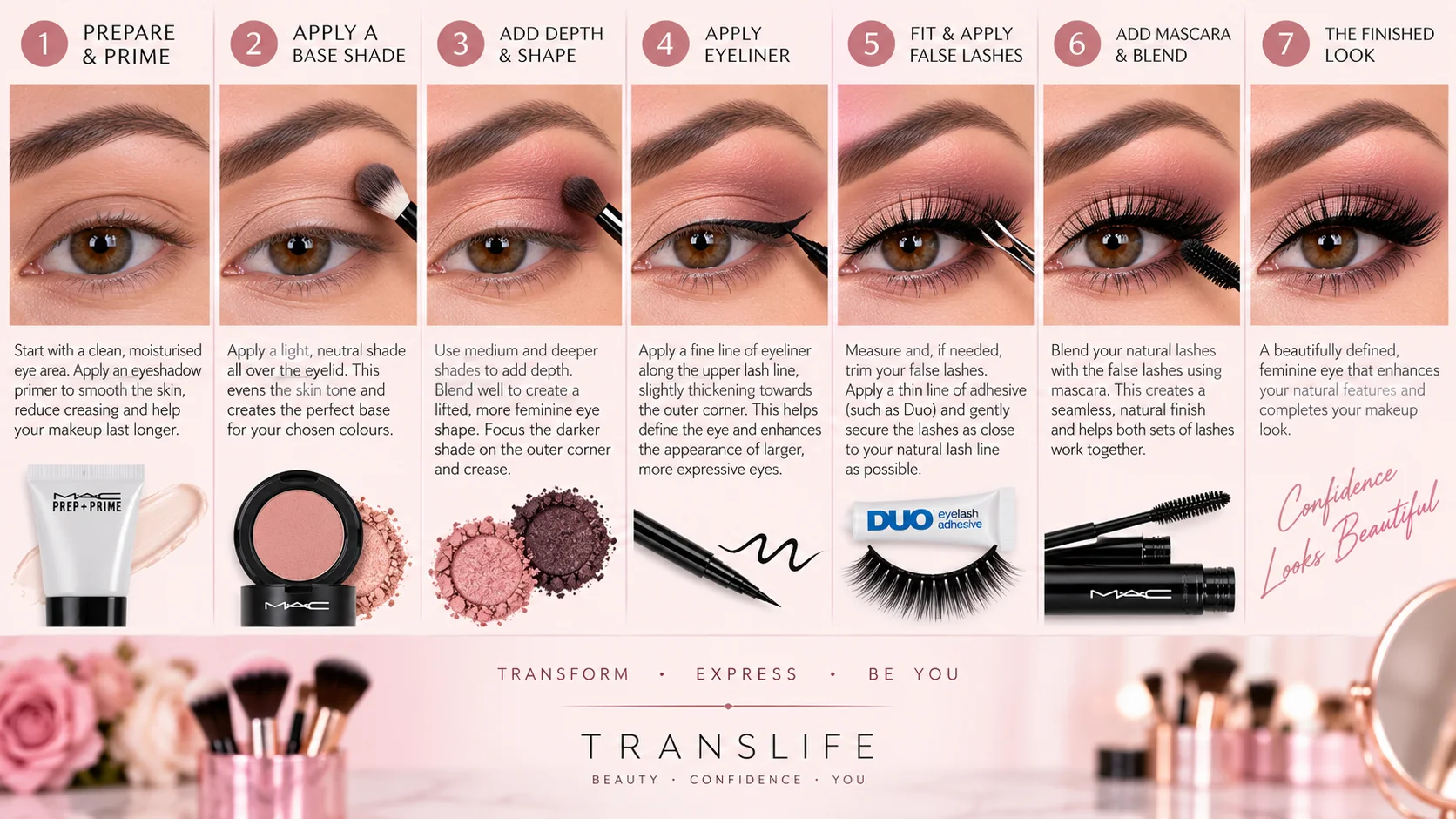
Pencil and Liquid Eyeliner Do Different Jobs
Eyeliner can add definition without every line needing to be hard or dramatic. Sophie uses different products depending on where the definition is needed and the effect she wants to create.
MAC Kohl Pencil
A kohl pencil such as Smoulder is useful when Sophie wants softer, dark definition, including careful use around the inner rim/waterline as part of the finished eye.
View MAC Kohl PencilKryolan Faceliner
Kryolan Faceliner provides another pencil option for eye definition. Pencil allows a softer effect than a crisp liquid line and can be worked into the overall eye rather than always remaining sharply drawn.
View Kryolan FacelinerKryolan Liquid Eyeliner
On the upper lid Sophie also uses liquid eyeliner. It gives a more precise, definite line along the lash line and can strengthen the eye before the false lashes are fitted.
View Liquid EyelinerChoose the Lash to Match the Look
False lashes can change the expression of the eye dramatically, but bigger is not automatically better. Sophie varies the style according to the finished look.
Daytime
For a daytime look, a lighter or less dense lash usually keeps the eye defined without allowing the lash to dominate everything else. It should support the eyeshadow and liner rather than hide them.
Evening
An evening look can generally carry a larger, thicker or more dramatic lash. Stronger shadow and liner can balance the additional lash volume, producing a more glamorous finished eye.
Use Dark Mascara to Blend Natural and False Lashes
Once the false lashes are in place, the job is not quite finished. Sophie uses traditional dark mascara to visually bring the natural lashes and false lashes together so they read as one finished lash line rather than two separate layers.
Blend, Do Not Overload
The purpose at this stage is integration. Work the natural lashes into the false lash effect without repeatedly loading the strip with unnecessary mascara.
Supreme Volume Mascara
A traditional dark mascara that can complete the eye and help blend the natural lashes into the false lash look.
View Supreme Volume MascaraTurn Loose Pigment into a Precise Liquid Colour
Once you are comfortable with ordinary pressed eyeshadow and blending, there are more creative ways to work. In Sophie’s Golden Eyes technique, Kryolan Mixing Medium is used with pigment to turn the dry colour into a liquid application that dries quickly and can be placed much more precisely.
Kryolan Mixing Medium
Mixing Medium changes how a suitable powder pigment behaves, allowing Sophie to create a more liquid, controlled application rather than relying on loose dry powder alone.
View Mixing MediumKryolan Pure Pigments
Pure Pigments provide intense loose colour and are particularly useful for this more advanced method. Used with Mixing Medium, the pigment can be turned into a precise fast-drying colour for deliberate placement.
View Pure PigmentsTake the Same Eye from Day to Evening
Keep Day Softer
Use the coordinated shade family with restrained depth, softer definition and a lighter lash. The eye can still be clearly feminine and polished without being heavily dramatic.
Build for Evening
Deepen the outer eye and definition, strengthen the liner where appropriate and choose a fuller lash. The important point is that an evening eye can grow from the same underlying method rather than requiring a completely different set of rules.
Products Used in the Techniques
Eye Shadow Trio Set
Coordinated Kryolan shades for building a blended eye from lighter colour through to deeper definition.
View Eye Shadow TrioLiquid Eyeliner
For the more precise upper-lid line Sophie uses as part of a defined eye.
View Liquid EyelinerSupreme Volume Mascara
Dark mascara for finishing the eye and integrating natural and false lashes.
View MascaraMixing Medium & Pigments
For the advanced liquid-pigment technique demonstrated in Sophie’s Golden Eyes video.
See Sophie Put the Eye Makeup into Practice
Written instructions explain the reasoning, but eye makeup is especially useful to watch because you can see the placement, blending and gradual build-up of colour.
Green Eyes
Crossdressing LifestyleWatch Sophie develop a complete eye look and see how colour, definition and the finished eye work together.
Watch Green EyesGolden Eyes
Crossdressing LifestyleIncludes Sophie’s more advanced use of Mixing Medium and pigment to create a precise liquid colour.
Watch Golden EyesComplete Makeup Playlist
Crossdressing LifestyleContinue into Sophie’s wider collection of practical makeup demonstrations and transformation techniques.
Explore Makeup VideosCommon Eye-Makeup Problems
The Shadow Looks Patchy
Check that the lid is prepared consistently and that you are building colour gradually. Trying to create full intensity in one application can make blending much harder.
The Colours Look Muddy
Blending does not mean mixing every shade together indefinitely. Soften the boundaries, then stop. Reintroduce a little of the individual shades if the shape has disappeared.
The Eyeliner Is Too Heavy
Do not keep making both sides thicker simply because one line is uneven. Practise a controlled line and remember that pencil can be used where a softer effect is more forgiving.
The False Lash Looks Separate
Check its position at the lash line and then use the finishing mascara stage to help integrate your natural lashes visually with the false lash.
Your Technique Will Become Your Own
When I do a makeover I am not trying to force every person into exactly the same eye. I can start from techniques I know work, but the amount of colour, the shape, the eyeliner and the lashes all have to make sense with the person in front of me and the look we are creating.
Brown-based shades are a very useful starting point because they are adaptable, but there is a whole world of colour beyond them. Practise the blending, learn what your brushes and products actually do, and then experiment. Some attempts will work better than others — that is how you learn.
The same applies to false lashes. A softer daytime look and a glamorous evening eye do not need the same lash. Choose what supports the finished look rather than assuming the biggest lash is always the most feminine.
Eye Makeup & False Lashes FAQs
What eyeshadow colours should I start with?
A coordinated brown-based range is a practical starting point because it works for many people and can be developed from a softer daytime look into a deeper evening eye.
Do I need both pencil and liquid eyeliner?
No. They create different effects. Sophie uses pencil such as MAC Kohl or Kryolan Faceliner for softer definition and liquid eyeliner on the upper lid when she wants a cleaner, more precise line.
Should daytime and evening false lashes be different?
They can be. Sophie generally uses a lighter lash for daytime and a larger or thicker style when the evening makeup can support more drama.
Why use mascara when I am already wearing false lashes?
Sophie uses traditional dark mascara to help visually blend the natural lashes with the false lashes so the finished lash line works together.
What does Mixing Medium do?
In Sophie’s Golden Eyes technique, Kryolan Mixing Medium is combined with suitable pigment to create a more liquid, fast-drying colour that can be applied precisely. It is an advanced option rather than something a beginner must use.
How do I get better at blending eyeshadow?
Practice. Build colour gradually, soften the transitions without mixing everything together, then restore a little depth if needed. Repetition teaches you how much pressure and product your own technique requires.
Practise, Blend and Experiment
Start with a manageable group of coordinated shades, learn how to blend them, add definition with the liner that suits the effect, then choose lashes appropriate to the occasion. Once those foundations feel comfortable, techniques such as pigments and Mixing Medium give you even more creative freedom.