Foundation & Concealer Guide
Build a smoother, more even feminine complexion by understanding what foundation and concealer actually do, where to use them and why controlled coverage usually looks better than simply applying more makeup.
Foundation and Concealer Have Different Jobs
Foundation creates the overall complexion. Concealer deals with particular areas that still need additional coverage or, when appropriate, subtle brightening.
For someone learning feminine makeup, it is easy to treat foundation as the answer to every mark, shadow or uneven area. That often leads to a heavier finish than necessary. A better approach is to prepare the skin, correct significant discolouration where needed, create an even foundation layer and then use concealer selectively.
Prepare the Skin Before Adding Coverage
Clean
Start with clean skin. Makeup applied over oil, residue or an uncomfortable shaving surface is harder to blend evenly.
Moisturise
Use skin preparation that suits you and allow it time to settle. A comfortable surface gives foundation a better starting point.
Assess
Look at the skin before covering it. Decide what genuinely needs correcting and what simply needs the overall foundation layer.
Correct Significant Discolouration First
If beard shadow remains after shaving, deal with that colour before expecting foundation to hide it. Sophie uses Dermacolor Camouflage Cream D32 as her established beard-shadow correction reference.
This guide does not repeat the full beard-cover technique. The important point here is sequence: targeted colour correction sits underneath the complexion makeup. Foundation then evens the skin rather than carrying the entire burden of neutralising strong blue-grey shadow.
Use a Genuine Full-Coverage Foundation
For a male-to-feminine transformation I want the foundation to give me dependable, even coverage. This is not the stage where I choose a very sheer base and then try to repair every remaining area with concealer.
I use professional full-coverage foundations. Kryolan TV Paint Stick is a long-standing part of the Translife kit, and MAC Cosmetics also produces excellent full-coverage foundation options. The exact brand and shade can change; the important point is choosing a foundation capable of creating the coverage the transformation needs.
Apply with a Sponge
I apply and work the foundation with a Beauty Blender or cosmetic latex wedges. The sponge helps distribute the product evenly across the surface rather than leaving heavy ridges or obvious areas of application.
Work methodically around the face and blend into the jawline and neckline. Add more only where the coverage genuinely needs building.
Do Not Confuse Coverage with Thickness
A full-coverage foundation is chosen because the pigment can do the work. It does not mean piling a thick layer over the face. Build an even surface, then stop when the complexion is doing its job.
Foundation & Concealer Application at a Glance
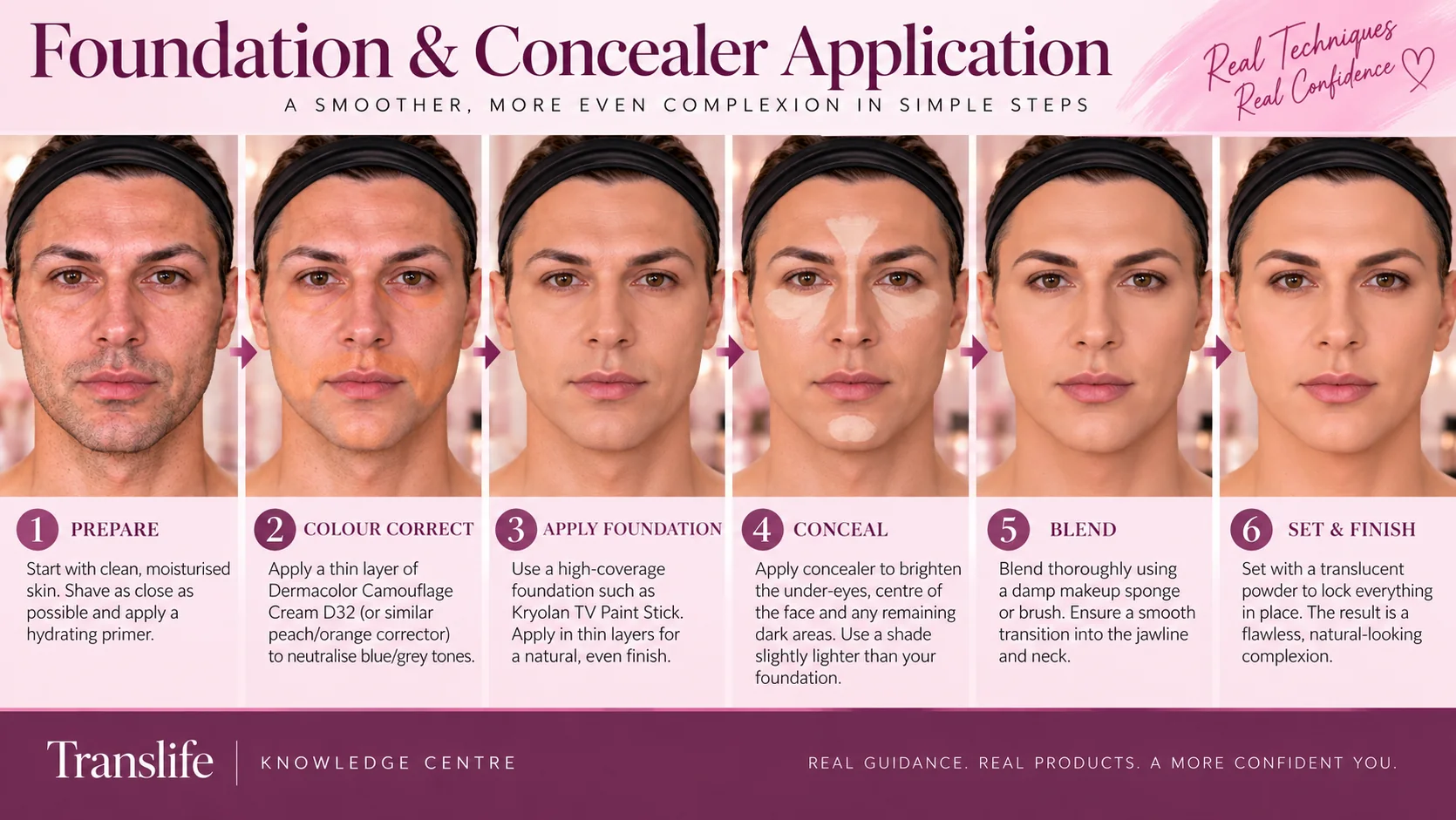
Concealer Is One Option — TV White Is Another
Once the full-coverage foundation is even, I look at what the face actually needs next. Conventional concealer can be used selectively for an area that still requires additional coverage, but it is not the only way I work.
Targeted Concealer
Use concealer where something genuinely remains to be concealed. For blemishes or local discolouration, the shade should merge naturally with the surrounding foundation rather than automatically being much lighter.
Kryolan TV White for Brightening
One of my alternatives is Kryolan TV Paint Stick in TV White. I use it sparingly beneath the eye area and through the facial “V” area as a highlighting and brightening technique. It is blended into the foundation rather than left as a stark white patch.
TV White is available within the Kryolan TV Paint Stick range.
Blend Before You Set
Use the Beauty Blender or latex wedge to make the foundation surface even and to merge any concealer or TV White highlighting into the base. Pay particular attention to the under-eye transition, sides of the nose, hairline, jawline and neckline.
The aim is not to wipe the foundation away. Press, blend and soften the joins until the complexion reads as one surface.
Seal the Foundation with Translucent Powder
Once I am satisfied with the foundation, I seal it. This is an important part of using a cream foundation such as TV Paint Stick: the base needs to be set so that it becomes more durable and the surface is ready for the makeup that follows.
Kryolan Professional Translucent Powder
I use translucent powder to set the foundation. Apply it evenly over the completed base and give it the opportunity to do its job before finishing the surface.
View Translucent PowderFinish with a Soft Natural-Hair Brush
After setting, I use a soft natural-hair blending brush to remove excess surface powder and buff the finish. This softens an overly powdery appearance and helps leave the complexion even and properly blended.
View Super Soft Blending BrushThe Working Sequence I Use
Correct
Neutralise beard shadow where required before asking foundation to cover it.
Full Coverage
Choose a proper full-coverage foundation such as Kryolan TV Paint Stick or an appropriate MAC full-coverage foundation.
Sponge Blend
Use a Beauty Blender or latex wedge to distribute and even the foundation.
Brighten
Use concealer where needed or carefully blend TV White beneath the eyes and through the V area.
Seal
Set the completed cream foundation with translucent powder.
Finish
Use a soft natural-hair blending brush to remove excess surface product and soften the finish.
Common Foundation & Concealer Problems
The foundation looks cakey
Too much product, too many corrective layers or an uncomfortable skin surface can make texture more obvious. Reconsider the amount before adding another layer.
Concealer looks too pale
A brightening shade may be too light or may have been spread too widely. Concealing and brightening are different jobs; not every concealed area should be lighter.
My beard shadow returns
Foundation may not be the missing step. If a blue-grey cast is showing through, review the colour-correction stage rather than repeatedly increasing foundation thickness.
The jawline is obvious
Check both colour match and blending. The face and neck should read as one believable complexion rather than two separate colours.
Foundation collects in lines
Heavy application and repeated powdering can emphasise movement and natural skin texture. Controlled product placement is particularly important around expressive areas.
It looks good indoors but wrong outside
Vanity lighting can disguise colour and blending differences. Check your complexion in good neutral or natural light before deciding it is finished.
I Want to See the Person, Not Just the Foundation
For me, the foundation stage is a process rather than a single product. I correct what needs correcting, use a proper full-coverage foundation, work it evenly with a sponge, add targeted brightness where it helps, seal the cream base with translucent powder and then finish it with a soft blending brush.
That routine has developed through doing real male-to-female makeovers. Beard shadow, perspiration, wigs and the length of time someone may be wearing their makeup all affect what I need the base to do. I therefore want dependable coverage, but I still want the finished complexion to look like a face rather than a layer of makeup.
I also keep stepping back and looking at the whole face. It is very easy to become obsessed with one tiny area in the mirror and lose sight of how convincing the complete transformation already looks.
Sophie’s Foundation Toolkit
These products are here because each has a defined job in the process rather than simply to add shopping links to the guide.
Kryolan TV Paint Stick
Professional full-coverage cream foundation. The same range also contains TV White, which I can use selectively for under-eye and V-area brightening.
View TV Paint StickBeauty Blender
Used to work, press and blend the foundation into an even surface. Cosmetic latex wedges can perform the same practical role.
View Beauty BlenderKryolan Professional Translucent Powder
The setting stage for sealing the cream foundation and creating a more durable base before the rest of the makeup is completed.
View Translucent PowderSuper Soft Blending Brush
A soft natural-hair finishing brush for removing excess surface powder and buffing the set foundation to a softer, more even finish.
View Blending BrushWatch Sophie Apply Makeup in Real Time
Step-by-Step Makeover
Watch Sophie work through a complete makeover in real time. It gives useful context for how complexion work fits into the wider transformation rather than existing as an isolated technique.
Watch the Full MakeoverMore Makeup Guidance
Continue through the Crossdressing Lifestyle makeup videos or explore the wider Translife Resource Hub.
Build the Rest of Your Feminine Makeup
Once the complexion is established, the transformation can move into the features that bring increasing definition and femininity to the face. The next specialist Translife guide will cover Eye Makeup & False Lashes.
Foundation & Concealer FAQs
Do I need both foundation and concealer?
Not necessarily. I start with a proper full-coverage foundation and then assess what remains. Conventional concealer can be used selectively, while TV White is another technique I use for controlled under-eye and V-area brightening.
Should concealer always be lighter than foundation?
No. A subtly lighter concealer can be used for brightening, particularly beneath the eyes. Concealer used to hide a blemish or local discolouration generally needs to merge naturally with the surrounding complexion.
Should I apply concealer before or after foundation?
For the approach described here, create the foundation base and then reassess what still needs concealing. Colour correction for strong beard shadow is a separate stage and is applied before foundation.
How much foundation should I use?
Use enough full-coverage foundation to create an even complexion and work it carefully with a Beauty Blender or latex wedge. Full coverage describes what the product can achieve; it does not mean the layer itself needs to be excessively thick.
Why does foundation make my skin texture look worse?
Excess product can collect around pores, lines and areas of movement. Skin preparation and controlled application are often more useful than adding another layer.
Do I need to put foundation all the way down my neck?
The objective is a believable transition, not automatically a heavily made-up neck. Blend the jawline carefully and assess whether additional product is actually required.
Why do I need to set a cream foundation?
In my routine the setting stage seals the cream base, improves durability and prepares the surface for the makeup that follows. I use translucent powder, then finish with a soft blending brush to remove excess surface powder and soften the result.
Create an Even Canvas, Then Stop When It Is Doing Its Job
My foundation routine is deliberately practical: correct where necessary, use a genuine full-coverage foundation, blend it evenly with a sponge, brighten selectively, seal the cream base with translucent powder and finish with a soft blending brush. Then step back and judge the whole complexion in real-world light.